Should you have eye surgery?
And if so, with which technique?
Myopia, astigmatism, hyperopia, presbyopia, cataract. Here you will find what you need to answer the first question yourself, and to understand the second one before you come and see me. Cachan and Paris 13.
the list of laureates
(Sorbonne Université)
Victor Hugo and Sainte-Geneviève
in your language
Start from your situation, not from the technique
Where are you with your eyesight?
You do not arrive with a technique in mind, but with an age and a difficulty. Start from your situation: the technique comes afterwards, and it is my job to tell you which ones are open to you.
I am 25 and I have had enough of glasses
Stable myopia, astigmatism or hyperopia. The most favorable ground for laser surgery.
See the laser techniques →I hold things at arm’s length to read
Presbyopia sets in around the age of 45. It can be corrected, on its own or at the same time as a pre-existing refractive error.
Understanding presbyopia →My vision is clouding over, headlights dazzle me
The first signs of cataract. Surgery is discussed when the difficulty becomes real, not before.
Cataract surgery →I am diabetic, or I have been referred
Screening and follow-up of diabetic retinopathy, AMD and retinal conditions.
Retinal follow-up →None of these boxes fits you? That is exactly what the consultation is for.
Book an appointmentTwo minutes, no e-mail address
Am I a candidate for surgery?
Ten questions, one click each. The answer appears straight away: the calculation runs in your browser, nothing is transmitted.
Have you already been told no? A refusal most often concerns one technique, not all of them: a cornea too thin for LASIK may still be suitable for PRK or a phakic implant. It also happens that a refusal is fully justified, and I will tell you so. Either way, you deserve to know what it was based on.
- The techniques that remain compatible with your profile, and those that are ruled out
- The specific points to have checked during the pre-operative assessment
- A one-page summary, to print or to keep on your phone
Your answers never leave your browser. Nothing is stored, nothing is sent, no contact details are requested.
The five techniques, side by side
LASIK, PRK, SMILE, PresbyLASIK or an implant: which one?
You arrive with these names in mind without knowing what sets them apart. Here is the comparison, on the criteria that actually decide.
Or click the name of a technique to show only that one.
| Criterion | LASIKCorneal flapisolated · click to close | PRKNo flapisolated · click to close | SMILEMicro-incisionisolated · click to close | PresbyLASIKAfter 45isolated · click to close | Phakic implant (ICL)Without touching the corneaisolated · click to close |
|---|---|---|---|---|---|
| What it corrects | Distance vision | Distance vision | Distance vision | Presbyopia, after 45 | Distance vision |
| Principle | Corneal flap, then laser reshaping | Surface reshaping, with no flap | Removal of a lenticule through a micro-incision | Multifocal LASIK: a near-and-distance profile shaped with the laser | An implant is added, without touching the cornea |
| Thin cornea | Often ruled out | Possible depending on the thickness | Depending on the correction | Same limits as LASIK | Preferred indication |
| High corrections | Limit reached sooner | Limit reached sooner | Same ceiling as LASIK | Not its field | Beyond the limits of the laser |
| Comfort in the first 48 hours | Generally good | The most uncomfortable of the five | Generally good | Generally good | Generally good |
| Visual recovery | Fast | Gradual, over several days | Fast | Fast, then adaptation over 4 to 6 weeks | Fast |
| Reversibility | No | No | No | No | The implant can be removed |
| Where it is performed | Clinique Laser Victor Hugo | Clinique Laser Victor Hugo | Clinique Laser Victor Hugo | Clinique Laser Victor Hugo | Clinique Sainte-Geneviève |
| Price, both eyes | 3 000 €first month’s follow-up included | 2 500 €first month’s follow-up included | 3 300 €first month’s follow-up included | 3 500 €first month’s follow-up included | from 4 700 €on quotation, depending on the implant, anesthetist’s fees not included |
| In a word | The most common, when the cornea allows it | The fallback for thin corneas and for athletes | Myopia and astigmatism, with no flap | The only one that targets near vision | High corrections, and the only reversible procedure |
| Going further | The LASIK page → | The PRK page → | The SMILE page → | The PresbyLASIK page → | The ICL implant page → |
None of these techniques is superior to the others: each has its own field. The pre-operative assessment determines which ones are open to you, and we choose among them together.
The four laser prices are packages: the procedure, the follow-up consultations of the first month and any laser enhancement during the first 6 months if it is medically justified. The phakic implant is placed in the operating theatre under anesthesia: its price depends on the implant, which is custom-made, and the anesthetist’s fees are added to it. None of these procedures is covered by the Assurance maladie. The item-by-item breakdown.
Two techniques still on your mind? Each head-to-head has its own page: LASIK vs PRK · LASIK vs SMILE · ICL vs LASIK
Do you want to see what someone with −3 of myopia sees? The vision simulator shows you, and asks nothing in return.
These five columns come down to one or two, once your measurements are known.
Check my eligibilityThe most frequently performed surgery in France
Cataract: the choice of implant decides the life that follows
The surgical procedure is standardized. What varies from one patient to another, and is talked about far too little, is the implant chosen to be placed.
Monofocal
One distance in focus, usually far. Reading glasses remain necessary. Covered by the Assurance maladie.
Toric
Also corrects astigmatism. Necessary if yours is significant, failing which the result disappoints. The toric implant.
Multifocal or EDOF
Aims at independence from glasses. Possible trade-offs for night vision, to be discussed frankly. EDOF implants.
Going further: the symptoms of cataract · the pre-operative assessment · premium implants · the postoperative course · the price of the procedure
Beyond laser and cataract
Retina, glaucoma, cornea: medical follow-up
Part of my practice involves neither refractive surgery nor cataract. At the Paris 13 · Diabet’ practice, dedicated to diabetic patients and retinal conditions, I provide screening and medical follow-up of the fundus, the retina and the optic nerve, as well as laser treatments when they are indicated.
Diabetic retinopathy
Screening and treatment: intravitreal injections, panretinal laser. Annual monitoring is recommended for every diabetic patient.
Diabetic retinopathy →AMD
Macular degeneration, dry or wet form. Cirrus 6000 OCT and TowardPi OCT-A, anti-VEGF injections.
AMD →Retinal detachment & ERM
Vitreoretinal surgery: vitrectomy, epiretinal membrane, macular hole. Emergency management when needed.
Retinal detachment →Glaucoma
Screening (eye pressure, HFA3 visual field, optic nerve OCT) and follow-up. Medical treatment or SLT laser depending on the stage.
Glaucoma →Paris 13 · Diabet’ practice
These consultations are mainly carried out at the specialized Paris 13 hub, equipped with a 200° ultra-widefield Optos, a Toward Pi YAlkaid OCT and a Quantel laser (SLT / YAG / Argon). Metro Place d’Italie (lines 5, 6, 7).
See the Paris 13 practice →See also: the retina · the cornea · keratoconus · dry eye · the technical platform
Who will operate on you
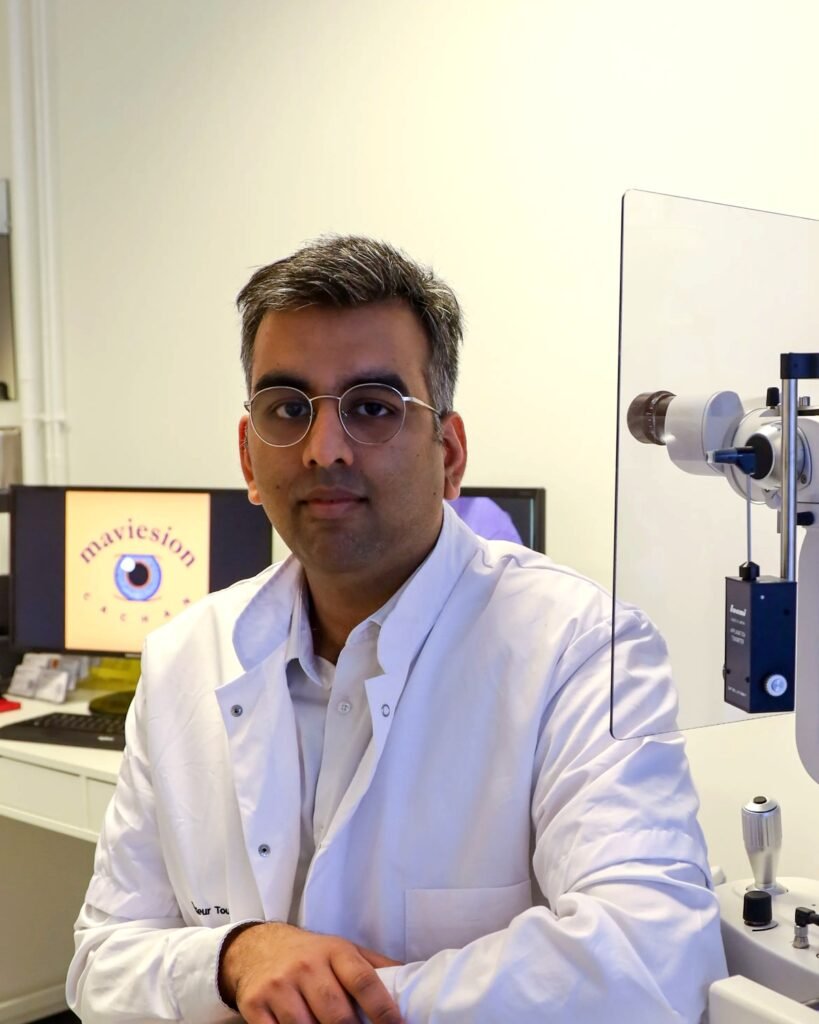
Dr Moïse Tourabaly
Former Chef de Clinique at the Hôpital National des Quinze-Vingts (Sorbonne Université), I practice refractive surgery, cataract surgery and the follow-up of retinal conditions.
You will see the same person at the consultation, in the operating theatre and at the follow-up visits. That is the reason why I hold consultations in Cachan and in Paris 13, and nowhere else.
The devices that will decide your eligibility have names, and you have every right to know them: CSO Sirius+ topographer, Zeiss Cirrus 6000 OCT, Zeiss IOLMaster 700 biometer in Cachan; Optos Daytona ultra-widefield retinal camera and Toward Pi YAlkaid OCT in Paris 13.
Publications: 8 works indexed on PubMed, 5 of them as first author — among them a systematic review published in Cornea in 2023 (PMID 37185592). 134 citations recorded by Google Scholar in August 2026.
Qualifications: Inter-University Diploma in Refractive and Cataract Surgery; Corneal Research Award of the Banque Française des Yeux.
What lies ahead, step by step
A structured protocol, from consultation to follow-up
The most frequent question is not a technical one. It is: how long does it take, and what exactly happens?
Consultation
Complete examination, discussion of the difficulty you actually experience and of your expectations.
Pre-operative assessment
Topography, corneal thickness, refraction. It is this assessment that decides, not the wish. The assessment in detail.
Procedure
Outpatient, under local anesthesia with eye drops. You go home the same day.
Follow-up
Scheduled check-ups, with the surgeon who operated on you.
Pricing information
The prices, right on the home page
Information about fees is a legal obligation, not a sales argument. Giving it early saves you having to look for it.
PKR
2 500 €both eyesLASIK
3 000 €both eyesSMILE
3 300 €both eyesPresbyLASIK
3 500 €both eyesPhakic implant (ICL)
from4 700 €both eyes, depending on the implant, anesthetist’s fees not includedWhat the laser package includes
- The procedure and the use of the operating theatre
- The follow-up consultations of the first postoperative month
- The bandage contact lens, when the surgical technique requires one
- Any laser enhancement during the first 6 months, if it is medically justified
The pre-operative assessment and the postoperative eye drops are billed separately. Your complementary health insurance can help you: many policies include an allowance dedicated to refractive surgery, which is not covered by the Assurance maladie. A detailed quote is given to you so that you can claim it, and the full price breakdown can be consulted at any time. Cataract surgery falls under a separate coverage scheme, explained during the consultation. The phakic implant (ICL) is the subject of its own quote, as the implant is custom-made.
A quote in your name is given to you at the end of the assessment, for your complementary health insurance.
Book an appointmentWhat patients who have had surgery say about it
What our patients say
4.9 / 5 from over 1,150 verified Google reviews. Six published accounts, reproduced word for word.
After LASIK surgery to correct my myopia, I can say two months on that the result is more than convincing. A big thank you to Dr Tourabaly, who looked after me very well; he took the time to explain how the operation would unfold so I could go into it with peace of mind. Very professional, conscientious and patient 👍
I’m writing 3 days after my refractive PRK surgery performed by Doctor Tourabaly. Everything went smoothly, and everything was clear from start to finish. My eyesight is better than I expected. If you have a job where glasses get in the way, this operation will change your life.
Excellent surgeon. I had retinal detachment surgery in each eye and cataract surgery in both eyes as well, that is 4 fully successful operations over 2 years. He has just operated on a secondary cataract with the laser, very successfully. I wholeheartedly recommend Doctor Tourabaly, in whom I have complete confidence.
I had myopia surgery 3 weeks ago now using the LASIK technique. Dr Tourabaly listens and explains things very well. The operation went very smoothly, and so did the follow-up before and after. I recommend him wholeheartedly.
I highly recommend Dr Tourabaly, whom I trusted for refractive PRK surgery for my myopia. Very professional and attentive to the patient.
Excellent surgeon, very attentive and available. No pain during or after the cataract surgery. I regained excellent vision thanks to the multifocal implants. I recommend him to you without hesitation.
Not decided yet, and that is normal
What patients ask most often
The questions that come up at every consultation. The answer is here; the link leads to the page that sets it out in detail.
Am I a candidate for refractive surgery?
Is laser surgery painful?
When can I go back to work after LASIK?
How much does the surgery cost? Is it reimbursed?
How many consultations are needed?
Is the correction permanent?
What is the difference between LASIK, PRK and SMILE?
Each question has its own dedicated page: Am I a candidate? · Refractive surgery · Safety · Sick leave · Prices · The pre-operative assessment · PresbyLASIK
Where I see you, where I operate
Where I see you
Consultations
Cachan practice
1 Ter Rue Camille Desmoulins
94230 Cachan
Dr Tourabaly’s consultations: Monday, Wednesday, Friday, 8:50 am–6:00 pm.
The practice is open Monday to Friday.
RER B Arcueil-Cachan, 5 min walk
Book — CachanParis 13 practice
12 Rue du Moulin des Prés
75013 Paris
Dr Tourabaly’s consultations: Tuesday, 8:50 am–6:00 pm. By appointment.
Metro Place d’Italie (5, 6, 7)
Book — Paris 13Centre Ophtalmologique Sorbonne Saint-Michel — Paris 5th
4 rue Domat
75005 Paris
Consultations with Dr Tourabaly. Dates and booking on Doctolib.
Metro Maubert-Mutualité (10) · Saint-Michel (4, RER B/C)
Book — Paris 5thWhere I operate
Operating theatres
Clinique Sainte-Geneviève
29 rue Sarrette
75014 Paris
ICL phakic implant, cataract, vitreoretinal surgery, corneal graft, pterygium.
The Cachan and Paris 13 practices, and the Paris 5th centre, are places of consultation: no surgical procedure is performed there. The date of surgery is set with you during the consultation. Directions and contact details, and the details of the Paris 13 practice. In an emergency, call 15.