Can you have several vision defects at once?
Yes, it is very common to have several vision defects at the same time: you can be both short-sighted and astigmatic, long-sighted and astigmatic, or short-sighted and presbyopic. These defects, known as refractive errors, affect different mechanisms of the eye. Because they do not depend on the same structure, they often add up in the same person, without one ruling out the other.
UNDERSTANDING
Why do vision defects add up?
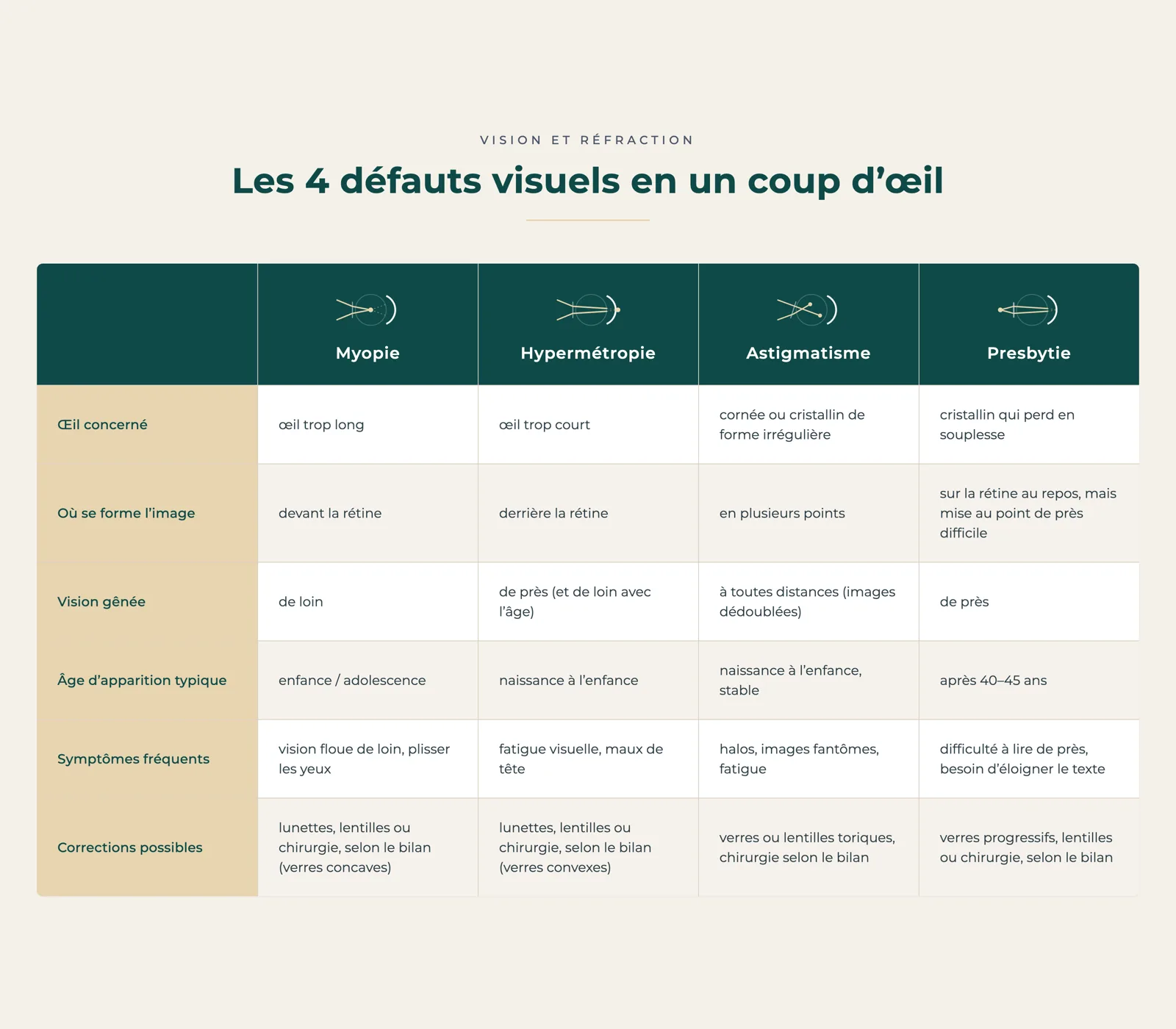
The sharpness of an image depends on several parts of the eye working together: the cornea (the clear surface at the front), the length of the eye and the lens (the internal lens). Each vision defect corresponds to a disturbance of one of these parts. Because they are independent, several can coexist.
An eye that is too long, or a cornea that is too curved, brings light to a focus in front of the retina: this is myopia (short-sightedness). An eye that is too short brings it to a focus behind the retina: this is hypermetropia (long-sightedness). These two defects mainly concern the length of the eye and the overall power of the optical system.
Astigmatism, by contrast, comes from an irregular cornea: instead of being round like a football, it is oval like a rugby ball. This curvature defect is separate from the length of the eye. That is why astigmatism very often adds to myopia or hypermetropia.
Finally, presbyopia affects the lens, which loses its flexibility with age and can no longer focus on near objects. It has nothing to do with the cornea or the length of the eye. That is why, after the age of 45, it adds to all the other defects already present.
COMBINATION
Can you be short-sighted and astigmatic at the same time?
Yes, this is one of the most common combinations. It is then called myopic astigmatism. The person has an eye that is too long or focuses too strongly (myopia) and, in addition, a cornea with irregular curvature (astigmatism). The two defects combine on the same prescription.
In practice, a patient who is both short-sighted and astigmatic sees blurred at distance, and this blurred image is also distorted or doubled along a particular axis. Car headlights at night may appear stretched into streaks of light. The correction then combines a value for the myopia and a value for the astigmatism, expressed in dioptres.
Whether you search for “short-sighted and astigmatic” or “astigmatic and short-sighted”, it is exactly the same situation: two defects present together. This combination is very well corrected by suitable glasses or contact lenses. Depending on the assessment, refractive surgery may also be considered to treat both defects at once.
COMBINATION
Can you be long-sighted and astigmatic?
Yes, this combination is just as real; it is called hypermetropic astigmatism. Here, the eye is too short (hypermetropia) and also has a cornea with irregular curvature (astigmatism). The two defects coexist in the same eye, as with the myopia-astigmatism combination.
A person who is long-sighted and astigmatic may experience blurred vision both at distance and near, often accompanied by eye strain and headaches at the end of the day. The eye constantly compensates through an effort of accommodation, which tires it out. In children, this combination deserves screening, as it can hinder learning.
Here again, the correction combines a value for the hypermetropia and a value for the astigmatism. All combinations of defects are possible: myopia and astigmatism, hypermetropia and astigmatism, and even astigmatism in each eye with different axes. Each eye is assessed separately during the examination.
AFTER 45
Can you be short-sighted and presbyopic, or long-sighted and presbyopic?
Yes, and it becomes inevitable with age. Presbyopia appears in almost everyone from around the age of 45, whatever vision defect is already present. So you can be short-sighted and presbyopic, long-sighted and presbyopic, or even short-sighted, astigmatic and presbyopic all at once.
Short-sighted and presbyopic
The short-sighted patient sees blurred at distance but often clear up close without glasses when they take them off. When presbyopia sets in, near vision deteriorates too. Many people with mild myopia then keep the habit of removing their glasses to read, while waiting for a correction suited to both distances.
Long-sighted and presbyopic
The long-sighted person often feels presbyopia earlier and more strongly. Their eye was already compensating through accommodation; when this weakens, near-vision difficulty arrives abruptly. The correction then combines the hypermetropia value and the addition needed for reading.
MEASUREMENT
How is a combined correction measured?
A glasses prescription translates all the defects present into a few figures expressed in dioptres. When several defects add up, each has its own column. Four main values describe the correction of one eye: sphere, cylinder, axis and addition.
- The sphere corrects myopia (a negative value, e.g. −2.00) or hypermetropia (a positive value, e.g. +1.50).
- The cylinder corrects astigmatism: it indicates the power to add along a specific axis.
- The axis (from 0 to 180°) specifies the orientation of the astigmatism on the cornea.
- The addition corrects presbyopia: it is the extra power for near vision.
A prescription such as “−2.00 (−1.00 x 90°) add +1.50” thus describes an eye that is short-sighted, astigmatic and presbyopic all at once. The presence of several values is therefore not a sign of severity: it is simply the numerical translation of defects that add up. To understand these units, our page on the dioptre explains what they mean.
CORRECTION
Can everything be corrected when defects add up?
In the vast majority of cases, yes: combined defects can be corrected effectively. Three main solutions exist, to be chosen according to the situation, age and needs of each person. None is universal, and the choice is always made after a full examination.
- Varifocal glasses: progressive lenses correct distance, intermediate and near vision in a single lens, including where astigmatism is present.
- Contact lenses: toric lenses treat astigmatism; multifocal lenses correct presbyopia combined with other defects.
- Refractive surgery: depending on the assessment, it can treat several defects in a single procedure.
SURGERY
Which surgery corrects combined defects?
When the pre-operative assessment confirms eligibility, several surgical techniques can treat several defects simultaneously. The choice depends on the thickness and shape of the cornea, the severity of the defects, and the patient’s age and activities.
LASIK and PRK: correcting myopia, hypermetropia and astigmatism
LASIK and PRK are excimer-laser corneal reshaping techniques. In a single session they treat myopia, hypermetropia and astigmatism, or a combination of the three. The laser is programmed to correct each component of the prescription. SMILE can also treat myopia combined with astigmatism through a minimal incision.
These techniques do not fully correct presbyopia, but a strategy known as monovision (one eye treated for distance, the other for near) can be offered to certain presbyopic patients who also have another defect.
Toric and multifocal implants
For patients whose cornea is too thin or whose defect is too high for laser treatment, the phakic implant (ICL) in its toric version corrects both high myopia and astigmatism. Toric multifocal implants make it possible to treat myopia or hypermetropia, astigmatism and presbyopia simultaneously, notably as part of cataract surgery.
Please note
Not all combinations of defects can be treated surgically. Eligibility depends on a complete pre-operative assessment: precise measurement of the cornea, of the axial length of the eye and of the state of the lens. Only this examination can determine the technique suited to each situation.
FAQ
Learn more
Frequently asked questions
Is it serious to have several vision defects at once?
No. Having defects such as myopia and astigmatism together is very common and not serious in itself. These refractive errors are corrected with glasses, contact lenses or sometimes surgery. An eye examination makes it possible to assess each eye and propose the suitable correction.
What is the difference between “short-sighted and astigmatic” and “astigmatic and short-sighted”?
None: it is the same situation, in which myopia and astigmatism are present together. The order of the words changes nothing. It is called myopic astigmatism. The correction combines a myopia value and an astigmatism value on the same prescription.
Can you be astigmatic and presbyopic at the same time?
Yes. Astigmatism comes from an irregular cornea, presbyopia from the ageing of the lens. These are two distinct mechanisms, so they often coexist after the age of 45. The correction combines a cylinder for the astigmatism and an addition for near vision, in suitable glasses or contact lenses.
Can a long-sighted person become short-sighted?
The same eye is not both short-sighted and long-sighted, because these two defects are opposites. However, the correction can change with age, and the onset of presbyopia or a cataract sometimes alters vision. A regular assessment makes it possible to monitor these changes.
Can all these defects be corrected with a single pair of glasses?
Often, yes. A progressive lens can correct myopia or hypermetropia, astigmatism and presbyopia at the same time. The lens incorporates the sphere, cylinder, axis and addition. Some patients prefer separate glasses for distance and near according to their comfort.
Can surgery treat several defects at once?
Yes, in eligible cases. LASIK, PRK and SMILE treat myopia, hypermetropia or astigmatism in a single session, alone or combined. The toric phakic implant corrects both high myopia and astigmatism. Eligibility is determined by the pre-operative assessment: not all combinations can be operated on.
Is a specific assessment needed when you have several defects?
Yes. When several defects coexist, the pre-operative assessment is all the more important: it measures each component (sphere, cylinder, axis, addition) in each eye, and evaluates the cornea, the axial length and the state of the lens. It is this assessment that determines whether surgery is possible and which technique is best suited to the combination of defects.
Sources
- French Society of Ophthalmology (SFO) — Refractive errors: myopia, hypermetropia, astigmatism, presbyopia.
- College of University Ophthalmologists of France (COUF) — Ametropia and ocular refraction.
- French National Authority for Health (HAS) — Recommendations on refractive surgery.
- Ameli.fr — Refractive errors and optical correction.
This article is intended for information only and does not replace a medical consultation. Only a complete eye examination can assess your vision defects and establish the correction suited to your situation.
A question about your vision?
Dr Moïse Tourabaly, former chef de clinique at the Quinze-Vingts hospital, carries out a full assessment of your vision and advises you on the corrections suited to your situation.
Written and reviewed by Dr Moïse Tourabaly, ophthalmic refractive surgeon — former chef de clinique (Quinze-Vingts National Eye Hospital).
Last updated: October 11, 2026